
Senior-Level Hiring Decisions shape far more than one vacancy. They influence strategy execution, team confidence, leadership culture, decision speed, and sometimes the direction of an entire function. That is why reducing risk at this level is not just a recruitment issue. It is a business issue.
Most organizations already know that a bad hire is costly. What they sometimes underestimate is how much more visible and disruptive that cost becomes when the role is senior. A weak hire in a high-impact position can slow delivery, damage trust, create leadership confusion, and force the organization into expensive course correction later. If you want to reduce that risk, the answer is not simply to move more slowly. It is to build a better decision process from the start.
What This Article Will Help You Do
This article will help you:
- understand why senior hiring carries a different level of risk
- identify the most common mistakes that weaken executive or senior-level selection
- build a more structured process for evaluating high-impact candidates
- improve confidence, defensibility, and long-term fit in leadership hiring decisions
Why Senior-Level Hiring Decisions Carry Outsized Consequences
The Cost Is Broader Than Compensation
At senior level, the cost of a hiring mistake is rarely limited to salary, recruiter fees, or onboarding time. It often includes lost momentum, delayed decisions, leadership instability, and avoidable pressure on the rest of the organization. SHRM has reported that hiring costs can become substantial even for standard roles, which helps explain why errors at executive and senior level tend to be far more expensive in practice.
The Impact Spreads Across Teams, Strategy, and Culture
A senior hire does not work in isolation. That person influences manager behavior, team priorities, communication standards, and execution quality. In large or regulated organizations, the effect can extend even further because senior roles often sit close to governance, workforce decisions, external relationships, or operational delivery.
Why Risk Increases in Complex Organizations
Multiple Stakeholders Create Mixed Signals
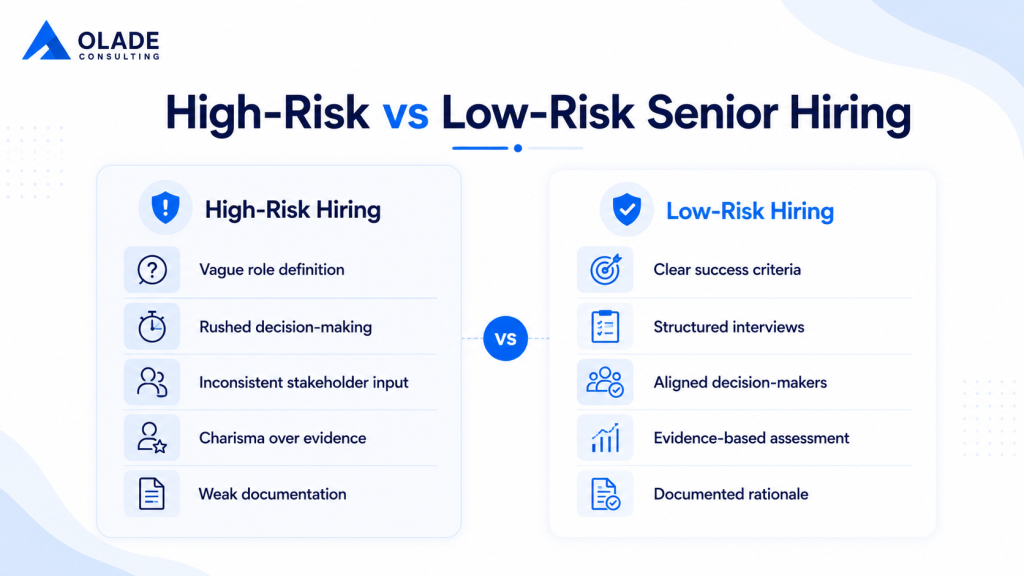
One reason senior hiring becomes risky is that too many people often influence the decision without fully aligning on the role. One stakeholder wants transformation. Another wants stability. Another wants technical depth. Another wants political skill. If those expectations are not reconciled early, candidates are assessed against a moving target.
Urgency Can Weaken Judgment
High-impact vacancies create pressure. When a role feels urgent, organizations can start treating speed as the main success measure. That usually leads to weaker evidence, inconsistent comparisons, or decisions driven by relief rather than fit.
Executive Roles Are Often Defined Too Vaguely
Senior roles are frequently described in broad terms like strategic, visionary, commercially minded, or collaborative. Those words sound useful, but they are not enough on their own. Without sharper role definition, the process becomes vulnerable to personal bias and shifting interpretation.
Read also – How Language Barriers Affect Hiring Decisions and Candidate Quality
The Blurred-Lens Analogy
Weak senior hiring decisions are like using a blurred lens in a high-stakes evaluation. The wrong details stand out, while the most important signals become harder to see. A polished communication style may get mistaken for sound judgment. A recognizable employer brand may get mistaken for true capability. A confident interview may overshadow weak evidence of execution.
That is why structure matters. It sharpens the lens. It helps the organization see what the role really requires and what the candidate has actually demonstrated.
What Actually Reduces Risk in Senior-Level Hiring Decisions
Start With Role Clarity
Define the Real Outcomes of the Role
Before assessing candidates, define what success in the role should look like over the next 12 to 24 months. What must this person actually deliver? What decisions will they own? What problems are they expected to solve? What leadership conditions will they inherit?
The clearer these outcomes are, the easier it becomes to judge candidates on relevant evidence rather than vague leadership language.
Separate Must-Have Criteria From Preferences
Many hiring processes weaken themselves by treating every desirable quality as essential. That inflates the profile and makes assessment less precise. Separate:
- true must-haves
- context-specific advantages
- trainable elements
- personal preferences that should not drive selection
This is one of the fastest ways to improve decision quality.
Use Structured Assessment Methods
Build Evidence-Based Interview Questions
OPM guidance notes that more structured interviews show higher validity, stronger rater reliability, and better defensibility than loosely structured approaches. That matters because senior roles often involve more judgment, not less. The process should be structured enough to compare candidates on relevant evidence.
Score Candidates Against Agreed Criteria
A strong senior hiring process uses clear criteria and agreed scoring logic. That does not mean the process becomes mechanical. It means judgment is applied against shared standards rather than changing personal impressions.
Read also – How to Improve Public Sector Hiring Outcomes Without Slowing Down Compliance
Strengthen Stakeholder Alignment
Agree on Role Priorities Early
If the executive team, HR, hiring leader, and panel are not aligned early, the process will drift later. Agree at the start on:
- the role purpose
- the top business outcomes
- the leadership challenges involved
- the capabilities that matter most
- the trade-offs the organization is willing to make
Reduce Late-Stage Opinion Drift
One common risk in senior hiring is late-stage redefinition. A candidate makes a strong impression, then the organization starts changing what the role needs in order to justify the choice. That is a dangerous pattern. Strong alignment early reduces that risk.
Test for Context Fit, Not Just Charisma
Look at Judgment Under Pressure
Senior leaders are hired to make decisions in difficult conditions, not just to present well in interviews. That means the process should test how candidates think through ambiguity, conflicting priorities, stakeholder pressure, or operational constraints.
Assess Leadership in the Environment the Role Will Face
A candidate can be excellent and still be wrong for the context. That is why fit should be assessed in relation to the actual environment. A leader suited to turnaround conditions may not be right for a role that requires steady institutional trust-building. A highly entrepreneurial executive may not be right for a regulated public environment.
Use Multiple Assessment Points
Structured Interviews
Structured interviews help reduce noise by ensuring candidates are assessed against the same broad areas. They also make panel comparisons more reliable. OPM and related federal guidance both strongly support the use of structured interviews for better reliability and defensibility.
Work Samples, Case Exercises, or Scenario Reviews
Senior candidates should often be evaluated through more than conversation alone. Depending on the role, useful options may include:
- case-based discussion
- stakeholder scenario review
- presentation on a realistic challenge
- structured problem-solving exercise
CIPD guidance on selection supports skill-based and structured assessment methods because they improve quality and fairness when used thoughtfully.
Read also – Performance Improvement Plan Questions
Document Decisions Clearly
Capture Why the Final Candidate Was Chosen
At senior level, decision confidence matters. The process should produce a clear answer to this question: why was this person selected over the others? The answer should relate directly to the agreed role criteria and evidence gathered through assessment.
Create a More Defensible Process
Documentation protects the organization in several ways. It improves transparency, supports governance, and helps future reviewers understand whether the process actually selected for the right things.
Common Mistakes That Increase Senior Hiring Risk
Hiring for Presence Instead of Evidence
Some candidates make a strong impression quickly. That is not the same as demonstrating fit. Executive presence matters, but it should not outweigh evidence of judgment, delivery, and context suitability.
Rushing Because the Role Feels Urgent
Urgency is real, but weak process creates slower recovery later. The right goal is not delay. It is disciplined speed.
Letting Stakeholders Redefine Success Midway
If the role criteria keep changing, comparison quality drops. That makes the final decision less dependable.
Confusing Impressive Experience With Role Fit
Big titles and recognizable employers can create false confidence. The better question is whether the candidate has shown the kind of capability this role specifically requires.
What Strong Senior-Level Hiring Decisions Look Like in Practice
Strong Senior-Level Hiring Decisions usually share four qualities.
Better Criteria
The role is clearly defined, and the organization knows what success should look like.
Better Evidence
Candidates are assessed using structured questions, multiple data points, and realistic decision criteria.
Better Alignment
Key stakeholders agree early and stay anchored to the same priorities.
Better Decision Confidence
The final choice feels grounded, explainable, and aligned to the organization’s goals.
How Olade Consulting Can Help
At Olade Consulting, we support organizations that need stronger structure, clearer role definition, and better hiring decisions for high-impact roles. Through staffing and recruitment, HR advisory, government and public sector advisory, and broader workforce solutions, we help clients build processes that are more practical, more consistent, and easier to trust. Olade’s public sector advisory work includes leadership pipelines, succession planning, HR frameworks, and inclusive recruitment practices, and its staffing and recruitment positioning reflects end-to-end support for critical hiring needs.
If your organization is reviewing how senior hires are assessed, shortlisted, or selected, this is a good time to strengthen the process before a high-stakes decision turns into an avoidable risk.
Practical Insight From an Executive Recruitment Consultant
Executive recruitment consultant Miriam Cole puts it this way: “The safest senior hiring decisions are not the ones with the most opinions in the room. They are the ones with the clearest evidence.” That is a useful standard. Senior hiring gets better when leaders do not ask who they like most, but who has shown the strongest fit for the role the organization actually needs filled.
Conclusion
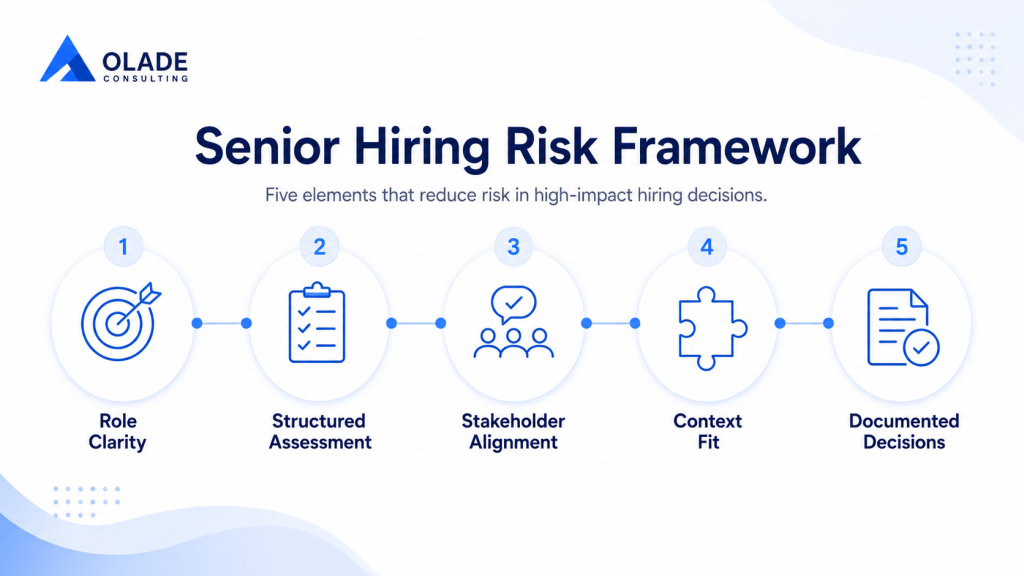
Reducing risk in senior hiring is not about making the process heavy or slow. It is about making it clear, structured, and evidence-based. The strongest Senior-Level Hiring Decisions begin with role clarity, use structured assessment methods, test for context fit, align stakeholders early, and document the final rationale properly.
When that discipline is in place, organizations improve both hiring quality and decision confidence. And when the role is senior, that improvement can influence far more than one appointment.
How We Can Help
Olade Consulting helps organizations strengthen hiring processes for critical roles through staffing and recruitment, HR advisory, government and public sector advisory, and workforce solutions. If your team needs support with senior role definition, structured assessment, shortlist quality, or defensible hiring design, contact Olade Consulting to explore how we can help.
FAQs
What is the biggest risk in senior-level hiring decisions?
The biggest risk is usually not a lack of candidates. It is weak evaluation design. When criteria are vague and evidence is inconsistent, organizations become more vulnerable to poor-fit decisions.
How can organizations reduce bias in senior hiring?
Use structured interviews, agreed criteria, multiple assessment points, and documented decision logic. CIPD guidance supports structured, objective, and transparent selection approaches for fairer outcomes.
Should senior roles always use executive search?
Not always. But senior roles often benefit from more structured search, sharper role calibration, and stronger assessment discipline than standard recruitment alone.
Why is role clarity so important before executive hiring starts?
Because unclear roles create inconsistent assessment. If success is not defined early, the hiring team cannot evaluate candidates against a stable standard.
How many assessment stages should a senior hiring process include?
There is no single perfect number. The right design depends on the role, but senior hiring usually benefits from more than one assessment point, especially when leadership judgment and context fit matter.